Social Justice & Inclusion

Introduction to Social Justice & Inclusion

The Social Justice and Inclusion competency is defined by action to understand one’s relationship with inclusion, oppression, and privilege. This includes working to understand how these are ingrained in and shaped by society and higher education institutions. Most importantly, this competency covers the founding systems of power in America that uplift and privilege whiteness while oppressing racial groups of the global majority that have been minoritized in the United States. This competency encompasses active work towards the inclusion and consideration of other minority groups, such as members of the LGBTQ community and those who are disabled. It is important to note that social justice and inclusion efforts are not limited to these areas and that these areas create intersections of privilege and oppression that affect individuals in different ways. 

Application of Social Justice and Inclusion

In the spring semester of my first year of the higher education program, I took College Student Experience. This course explored the experiences of different college students and gave us the opportunity to write a research paper on an area of interest at the end of the semester. As we studied, we discussed disability in the physical sense but did not mention much about the intersection of the college experience of those with learning or neurodevelopmental disabilities.  With this in mind, I focused my research on women with ADHD and their transition to college, specifically on their transition outside of academics. I noticed a gap in the literature on this specific student experience and wanted to fill it, exploring how this specific type of student experiences higher education.  There is still so much about the student experience yet to be explored, especially as society at large and higher education gain more vocabulary and more voice for the experiences of those marginalized. I hope to further continue this research into my professional career. Filling in gaps where there is great potential for disability justice and accessibility support in programming and student affairs to benefit the college student experience is a way I hope to actively better the communities I work with.

Progress and Future Growth

A measure of success and growth in this competency means that I constantly self-evaluate and continue my journey to learn more about those with different experiences than myself. This includes bias evaluation within and outside the workplace to make myself a more dedicated agent of change. Evaluating implicit biases will help me to guide my interactions and my future learning in the workplace. On top of my education on how racism and structural injustice occur within higher education, I hope to be able to critically look at the act of perpetuating white ideas as sole ways of being at a university. As an avid reader, I will also continue to dedicate time to reading non-fiction and further my knowledge of the lived experiences of future students and coworkers, as well as specific practice-based theories and skills. This will help me adapt as the conversation around social justice and inclusion grows and expands, and be a more active participant in diversity, equity, and inclusion work. Intentionally advocating for social justice and inclusion is something I hope to embody in every aspect of my work. 
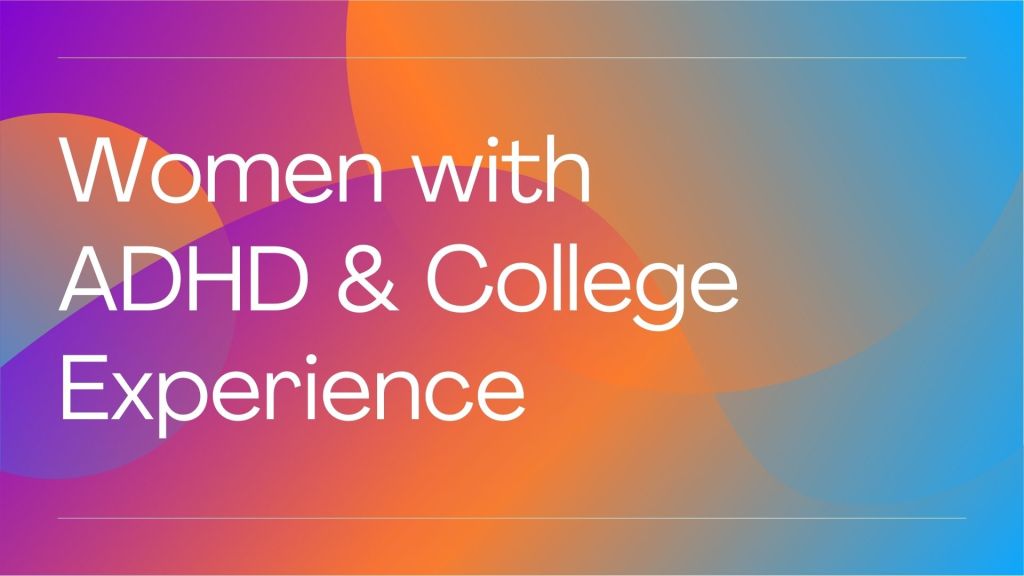
  • Abstract rainbow shapes in the background for all images in the carousel. White text reads Women with ADHD and College Experience.
  • White text reads What is ADHD? Attention Deficit/Hyperactivity Disorder Neurodevelopmental Disorder * Inattentive: Difficulty Organizing, Trouble with attention to detail, Being forgetful Difficulty paying attention, Losing things Easily, * Hyperactive: Fidgeting, Excessive Talkativeness, Impulsivity, Accident-Prone *Combined
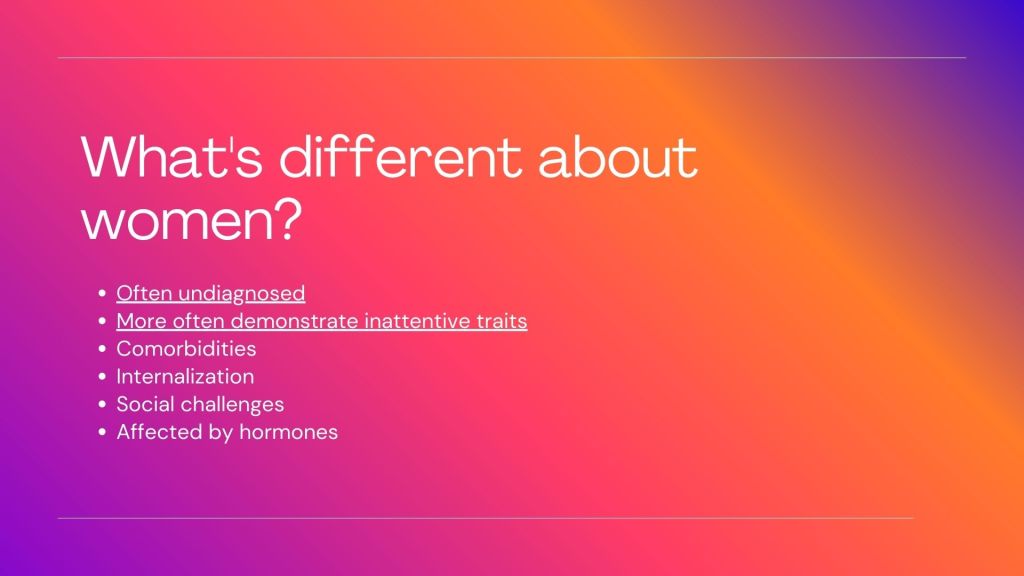
  • White text reads What's different about women? Often undiagnosed More often demonstrate inattentive traits Comorbidities Internalization Social challenges Affected by hormones
  • White text reads Areas of Interest.
  • White header reads Transition to College. White text contains bullet points that read Less likely to use/have access to university accommodations, Move from mostly structured to mostly unstructured time, Difficulty staying engaged & staying enrolled, Lower grades due to lack of exective functioning skills
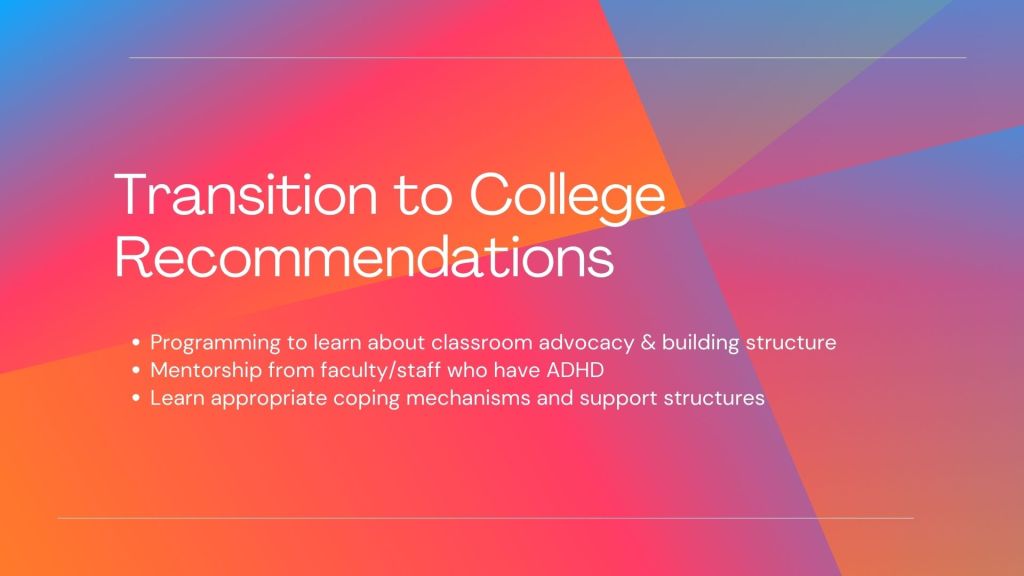
  • White header reads Transition to College Recommendations. Bulleted white text reads programming to learn about classroom advocacy and building structure, mentorship from faculty/staff who have ADHD, learn appropriate coping mechanisms and support structures.
  • White header reads Relationships. Two sections are titles Friendships and Romantic partners from left to right. Under friendship, bulleted white text reads Difficulty emotionally regulating, higher stress levels, more prone to interpersonal conflict, Higher rates of peer rejection, Hard to sustain multiple friendships at once (difficulty maintaining contact / remembering, inattention). Under romantic partners, white bulleted text reads Romantic/Intimate relationships are an important part of emerging adulthood, Higher risk of experiencing intimate partner violence (IPV), Impulsivity and lack of awareness increases likelihood of victimization, Symptoms of internalization increase likelihood of low self-esteem, which is a predictor of IPV
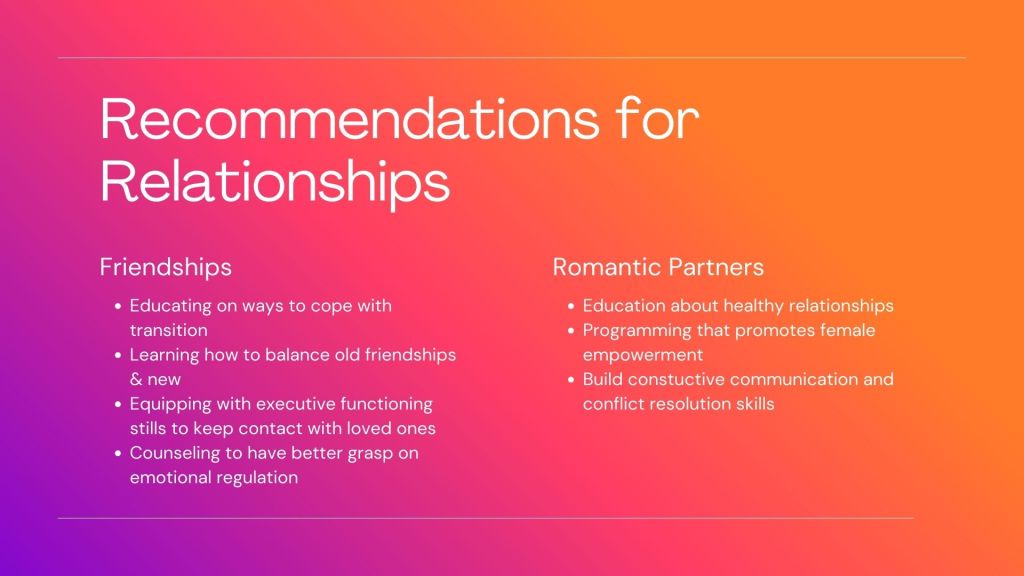
  • White header reads Recommendations for Relationships. Two sections are titles Friendships and Romantic partners from left to right. Under friendship, bulleted white text reads Educating on ways to cope with transition, Learning how to balance old friendships & new, Equipping with executive functioning stills to keep contact with loved ones, Counseling to have better grasp on emotional regulation. Under romantic partners, white bulleted text reads Education about healthy relationships, Programming that promotes female empowerment, Build constuctive communication and conflict resolution skills
  • White header reads Implications for Practice. Under in white text reads Universal Design, Greater Awareness, and Holistic Support
  • White text reads references. White text reads Antoniou, Rigas, N., Orovou, E., Papatrechas, A., & Sarella, A. (2021). ADHD Symptoms in Females of Childhood, Adolescent, Reproductive and Menopause Period. Materia Socio-Medica, 33(2), 114–118. https://doi.org/10.5455/msm.2021.33.114-118 Bruner, Kuryluk, A. D., & Whitton, S. W. (2015). Attention-Deficit/Hyperactivity Disorder Symptom Levels and Romantic Relationship Quality in College Students. Journal of American College Health, 63(2), 98–108. https://doi.org/10.1080/07448481.2014.975717 Buchanan, & LeMoyne, T. (2020). Helicopter Parenting and the Moderating Impact of Gender for University Students with ADHD. International Journal of Disability, Development, and Education, 67(1), 18–27. https://doi.org/10.1080/1034912X.2019.1634794 Devlin, M., & Bushey, H. (2019). Using Data Holistically to Create a Student Success Safety Net. Change: The Magazine of Higher Learning, pp. 17-25. Gormley, M. J., DuPaul, G. J., Weyandt, L. L., & Anastopoulos, A. D. (2019). First-Year GPA and Academic Service Use Among College Students With and Without ADHD. Journal of attention disorders, 23(14), 1766–1779. https://doi.org/10.1177/1087054715623046 Guendelman, Ahmad, S., Meza, J. I., Owens, E. B., & Hinshaw, S. P. (2016). Childhood Attention-Deficit/Hyperactivity Disorder Predicts Intimate Partner Victimization in Young Women. Journal of Abnormal Child Psychology, 44(1), 155–166. https://doi.org/10.1007/s10802-015-9984-z Kelley, English, W., Schwallie-Giddis, P., & Jones, L. M. (2007). Exemplary Counseling Strategies for Developmental Transitions of Young Women With Attention Deficit/Hyperactivity Disorder. Journal of Counseling and Development, 85(2), 173–181. https://doi.org/10.1002/j.1556-6678.2007.tb00460.x Smyth, Dipeolu, A., Davies, L., Hargrave, S., & Stevenson, A. R. (2015). LIVING WITH ADHD: The Unique Career Development Challenges Facing Women with ADHD. Career Planning and Adult Development Journal, 31(4), 44. Snyder. (2015). The Link Between ADHD and the Risk of Sexual Victimization Among College Women. Violence Against Women, 21(11), 1364–1384. https://doi.org/10.1177/1077801215593647 Vingilis, Erickson, P. G., Toplak, M. E., Kolla, N. J., Mann, R. E., Seeley, J., vanderMaas, M., & Daigle, D. S. (2015). Attention Deficit Hyperactivity Disorder Symptoms, Comorbidities,Substance Use, and Social Outcomes among Men and Women in a Canadian Sample. BioMed Research International, 2015, 982072–982078. https://doi.org/10.1155/2015/982072 Wells, M. B. (2022). Supporting Higher Education Students with Attention Deficit Hyperactivity Disorder through Universal Design for Learning, College Teaching, DOI: 10.1080/87567555.2022.2160959